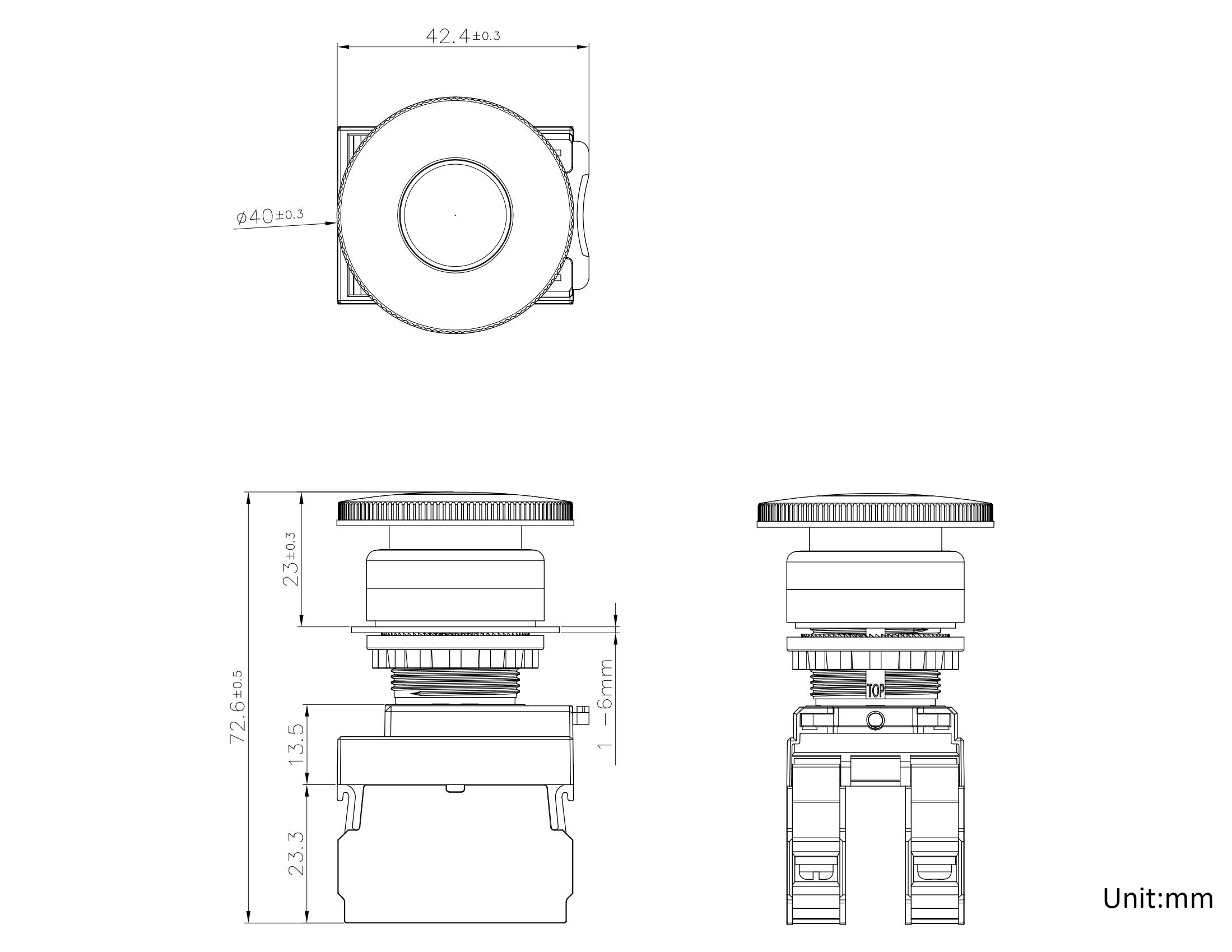
SLA6H-M
CN·SL
| Availability: | |
|---|---|
| Quantity: | |
Construction machinery does not operate in controlled environments. Panels vibrate. Engines generate continuous oscillation. Operators apply force while wearing gloves. Dust and debris are present at all times.
This shock-resistant on/off push button is designed specifically for these conditions.
The switching mechanism delivers a firm mechanical engagement. The tactile response is solid and defined. There is no loose movement, no soft travel, no uncertain contact. When actuated, the operator feels a direct mechanical confirmation.
Internally, the contact structure is reinforced to reduce displacement caused by vibration. Contact pressure remains stable under shock load. The switching action maintains electrical continuity without intermittent fluctuation.
Externally, the housing is thickened and impact-resistant. The button cap resists deformation under repeated force. Once installed on heavy equipment control panels, the component maintains structural integrity and switching reliability over long service cycles.
This is a functional industrial control component built for operational stability — not cosmetic panel design.
Reinforced spring mechanism
Stabilized contact assembly
Reduced contact bounce under vibration
Consistent conductivity during heavy operation
Impact-resistant outer shell
Thickened structural walls
Designed to resist mechanical stress
Suitable for outdoor machinery installation
Positive mechanical switching feedback
Clear actuation force
Reduced risk of accidental triggering
Reliable maintained position control
Excavators
Road construction machinery
Concrete equipment
Drilling rigs
Industrial transport units
Manufactured under standardized procedures
Mechanical and electrical inspection before shipment
Consistent batch stability
Parameter | Specification |
|---|---|
Product Type | On/Off Push Button |
Operation | Maintained |
Application | Construction Machinery |
Mounting | Panel Mount |
Structural Design | Shock-Resistant Reinforced |
Housing Material | Industrial-Grade Durable Material |
Certification | Certified |
Environment | High Vibration / Outdoor Use |
Detailed electrical ratings and configuration options are available upon request.
The contact module is engineered to minimize micro-displacement under vibration.
Spring force calibrated for stable engagement
Contact pressure optimized for continuity
Reduced mechanical looseness
Stable switching cycle performance
This prevents signal interruption caused by panel oscillation.
Rigid body structure
Reinforced button cap
Designed for impact resistance
Structural stability under repeated mechanical load
The result is a component that maintains consistent performance in environments with continuous mechanical disturbance.
This push button is designed for:
High-vibration control panels
Mobile construction equipment
Outdoor installations
Dust-intensive worksites
Continuous operation cycles
It performs reliably under sustained mechanical stress where general-purpose push buttons experience premature wear.
Conventional Push Button | Shock-Resistant Model |
|---|---|
Susceptible to vibration shift | Stabilized internal structure |
Contact bounce under load | Reinforced contact pressure |
General industrial usage | Heavy machinery application |
Light structural housing | Impact-resistant construction |
The difference is structural integrity.
In dynamic environments, structural stability directly determines electrical reliability. This model is engineered with that principle as the foundation.
Each unit undergoes inspection procedures including:
Mechanical switching cycle verification
Contact continuity testing
Structural integrity inspection
Functional performance checks
Production follows standardized quality control processes to ensure consistency in performance.

Yes. The reinforced internal contact structure reduces instability caused by vibration and shock.
Yes. The housing structure is designed for field equipment and exposed environments.
The internal stabilization and reinforced structure provide improved resistance to mechanical shock and vibration.
Yes. It is designed for panel mounting in construction and industrial machinery control systems.
Yes. Contact configuration and structural variations can be provided based on application requirements.